The trees along the greenbelt are dropping their leaves, hard frosts are arriving more often now, and if you’ve lived in the Snake River valley long enough, you know what’s coming. Winter here isn’t just cold. It’s dry, it’s windy, and it can arrive fast. At roughly 4,700 feet in elevation, Idaho Falls and the surrounding areas have their own particular way of punishing trees that weren’t prepared. We’ve been doing tree service in Idaho Falls for
30 years, and every spring we see the same preventable damage in yards all over town. The time to stop that cycle is right now, before the ground locks up.
Why Fall Is When Winter Damage Actually Begins
Most people think of winter tree damage as something that happens in January. The ice storm, the heavy snow load, the bitter cold snap. But the truth is, most of the damage we see in spring was set up in fall, when trees were going into dormancy stressed, structurally compromised, or poorly watered.
A tree entering winter under drought stress is working with depleted moisture reserves in its wood and root system. Eastern Idaho’s high-desert climate means we already push trees to their limits in a normal summer. Add a dry fall on top of that, and the bark cracks, the branch wood becomes more brittle, and the roots have less grip in loose soil. When February winds load those branches, you get failure. When a late March snow hits a tree that’s already on the edge, something comes down.
The work you do now, while the leaves are still falling and the soil is still workable, is what determines how your trees come through next April.
The Fall Trimming Window Is Open Right Now
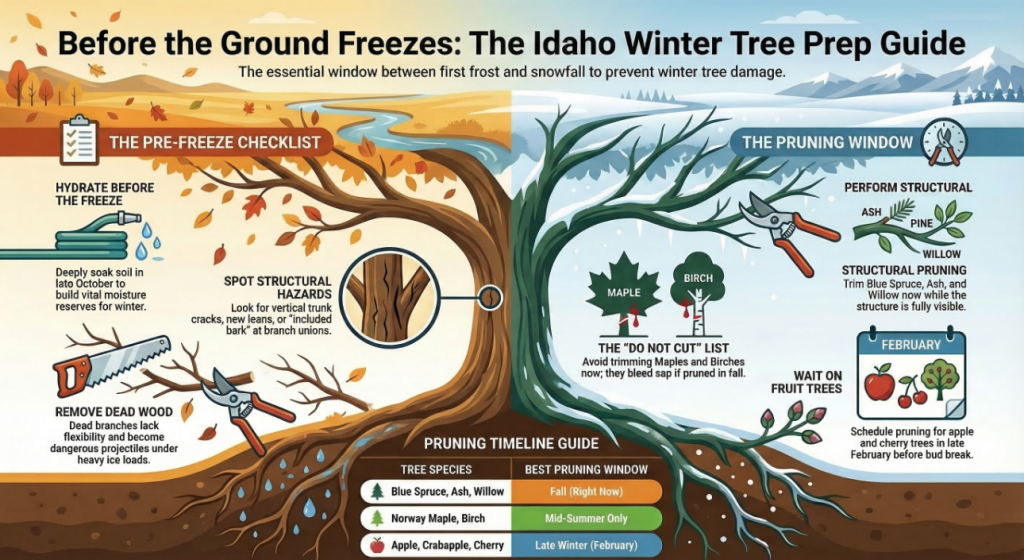
With leaves off or coming off, this is one of the best times of year for tree trimming in Idaho Falls and the surrounding valley. The structure of every tree in your yard is fully visible. Dead branches, weak unions, crossing limbs that rub and create wound entry points, all of it is right there to see. We can make better pruning decisions in November than we can in July when a full canopy is hiding half the tree.
This applies to most trees common in Idaho Falls yards: blue spruce, pine, ash, willow, linden, honeylocust, aspen, poplar, and Siberian elm. Now is the right time for structural pruning on all of these.
One exception worth repeating: Maples and birches should not be trimmed in fall or early spring. Both trees bleed sap heavily when pruned outside of midsummer, and that stress going into winter can cause real damage. If you have a Norway maple in your yard, put it on the list for July. It will keep.
Fruit trees, including apple, crabapple, and Canadian cherry, are best pruned just before bud break in late winter. Don’t prune those now. Mark them for February and keep an eye on the buds as spring approaches.
What to Check Before the Snow Arrives
You don’t need to hire an arborist in Idaho Falls to do a useful walk-around of your own yard. Here’s what we’d look at before the first real snowfall.
Dead wood in the canopy. Dead branches hold snow and ice like a sail and have none of the flexibility of live wood. A branch that looks fine in summer can become a projectile in a February ice storm. Look up. If you see significant dead wood in your ash, pine, or spruce, that’s worth addressing before winter sets in.
Included bark at branch unions. This is where two branches grow together at a tight angle and compress bark between them instead of forming solid wood. It looks like a crease or seam where a branch meets the trunk. Unions like that are a liability under heavy snow and should be looked at by someone who knows what they’re seeing.
Any visible lean that wasn’t there before. After the windy falls we see across the Snake River Plain, it’s worth checking whether any trees have shifted. If a tree looks like it’s sitting at a different angle than it was in summer, check the base for soil heaving or roots beginning to lift. That’s a conversation to have before three feet of snow adds to the problem.
Cracks in the trunk. Frost cracks can develop or worsen over winter, especially in drought-stressed trees. Check the main trunks on your willows and elms in particular. Vertical cracks that are new or actively opening need to be assessed.
If there’s a branch that looks like it’s ready to come down on the next windy night, don’t wait for that to happen. A hanging or partially cracked limb is unpredictable. Stay clear of it and call us. We handle hazard branches throughout Idaho Falls, Ammon, Rigby, and the surrounding valley every week.
The Watering Question Nobody Asks
One of the most underappreciated things you can do for your trees before winter is a deep, slow watering in late October or early November, before the ground freezes. This is especially true in low-snowpack years, which have become more common across Eastern Idaho.
Trees go into dormancy, but their roots don’t completely shut down. A good soak before freeze-up builds moisture reserves in the root zone that carry the tree through the dry months. A tree going into winter on a full tank is in a fundamentally different position than one that’s been dry since August. It handles temperature swings better, suffers less bark cracking, and comes out of dormancy with more energy to push into spring growth.
If you’ve already had a hard frost or two, water on the next stretch of days above freezing. There’s usually still time before the ground locks up for good, even in areas like Ririe, Firth, and Swan Valley where temperatures can drop faster than people expect.
When It Makes Sense to Call Us
A lot of fall tree care is well within what an attentive homeowner can manage. Raking, light cleanup, a deep watering before the ground freezes. But the structural work, removing significant dead wood from a large ash or pine, evaluating branch unions on a tree near your house, making clean pruning cuts on a mature linden or spruce rather than damaging ones, that’s where 30 years of Eastern Idaho tree care experience makes a real difference.
We’re licensed, insured, and we bring the right equipment to every job. We also give honest assessments. If something is fine and just needs monitoring, we’ll tell you that. If there’s a branch that looks like it’s ready to come down before spring, we’ll tell you that too, and we’ll take care of it safely.
Fall goes fast in the valley. A week of warm weather, then a hard freeze, and suddenly the season has moved on. If you’ve been meaning to get eyes on your trees, now is the time.
Roberts & Sons’ Tree Service, Inc. serves Idaho Falls, Ammon, Rigby, Shelley, Rexburg, Blackfoot, Island Park, Roberts, Firth, Ririe, Swan Valley, and the surrounding Eastern Idaho valley. Licensed, insured, fair prices, and 30 years of experience in this exact climate.